
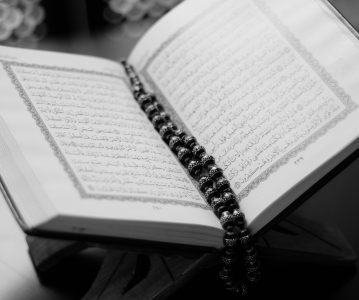

53:33 Have you seen the one who turned away 34 And gave a little and [then] refrained?
35 Does he have knowledge of the unseen, so he sees?
36 Or has he not been informed of what was in the scriptures of Moses 37 And [of] Abraham, who fulfilled [his obligations] – 38 That no bearer of burdens will bear the burden of another 39 And that there is not for man except that [good] for which he strives 40 And that his effort is going to be seen – 41 Then he will be recompensed for it with the fullest recompense –
Koran 53:33-41
Muhammad, in his Koran, addresses a sentence, verse, or passage to “Anonymous They”, with “they”, “them”, “he”, “your”, “the people”, and so on, without naming them. For more, read Anonymous They.
Muhammad asks rhetorical questions which are only to his Muslims, in his time and place, his context, showing that Koran, Islam, and Allah are local to Muhammad, and so are all false.
Notice Muhammad starts off with non-sexist language: “Have you seen the one who turned away”, but then switches to sexist language: “Does he have knowledge of the unseen, so he sees?” What happens to Muslim women? Muhammad is obviously ranting about one man. Who? Muhammad fails to communicate, showing the Koran is Muhammad’s rantings, not communication from a real god.
This passage is another passage that relies upon Torah and the Bible being correct, thus contradicting the current Muslim apologetics nonsense that claims Torah and the Bible are corrupted.
Notice that in verses 36- 41, the sentence ends with a dash “-” and there’s no question mark. This looks like a translation problem mixed with a tafsir division problem, which indicates that Muhammad is unclear in his rhetoric. Let’s recall that Muhammad is supposed to be the messenger here, yet Muhammad is clearly failing here in communicating his message to this unnamed man; instead, Muhammad is ranting to his secretary.
Muhammad fails at being a messenger. Not surprisingly, as he’s also a false prophet, for a false god, Allah, for a false religion, Islam, without even a false book, the Koran.
The best replacement for this passage is: “”, the empty sentence.


[…] that the first verse 42 seems to fit better with the previous passage in Koran 53:33-41. This looks like a translation problem mixed with a tafsir division problem, which indicates that […]
LikeLike
[…] Qur’an 53:33-41 […]
LikeLike