
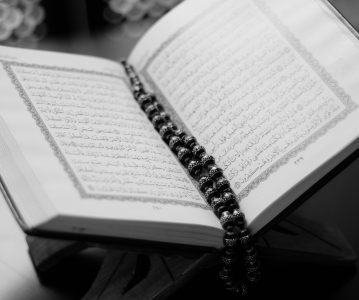

And We had certainly given Luqman wisdom [and said], “Be grateful to Allah.”
And whoever is grateful is grateful for [the benefit of] himself.
And whoever denies [His favor] – then indeed, Allah is Free of need and Praiseworthy.
Koran 31:12
Muhammad commits shirk with “We”, “Us” or “Our”, placing Allah as a companion to himself, showing that Allah is incoherent, imaginary, and fictional. So Islam is incoherent with monotheism; thus, Islam is contradictory and false.
Muhammad spoke about Allah in the third person. This means this passage is not the perfect words of the perfect Qur’an from perfect Allah. Thus, Allah is false, imaginary, and fictional, which means Islamic doctrine and Islam are nonsensical and false.

Who is Luqman? There’s a boring story about him in Tafsir Ibn Kathir, 31:12. From the Tafsir, Luqman seems to be a slave of a foolish Quraysh polytheist pagan. This means this story is locked to Muhammad’s time, place, and context, showing this passage is local to Muhammad and so false.
And why were “We” speaking to him? Luqman being a slave isn’t something to be thankful for. Notice that in the story the scholars have, Luqman seems unaware of “We” speaking to him.
Notice that “We” can speak to others inside Muhammad’s verses (yet Luqman is unaware of this), yet cannot speak to anyone outside of Muhammad (except from inside Muhammad). This shows the weakness of “We”, lying to Muhammad, and so lying to others.
This verse talks about an Ethiopian slave to a foolish Quraysh pagan in the past, which seems to make sense only to the Quraysh, perhaps, and which we only know about through Tafsir Ibn Kathir, 31:12. Obviously, this is incompetence on the part of Muhammad and imaginary Allah. This is a name-dropping.
The best replacement for this passage is: “”, the empty sentence.

 Koran Contradiction
[…] Qur’an 31:12 […]
LikeLike