
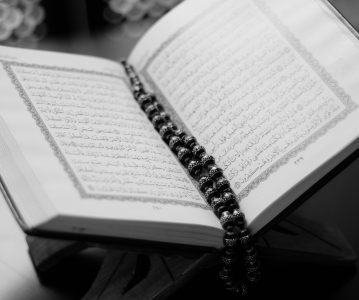

And do not pursue that of which you have no knowledge.
Indeed, the hearing, the sight and the heart – about all those [one] will be questioned.
Koran 17:36
This verse seems to be about not following a religion that you know nothing about. But instead, according to Tafsir Ibn Kathir, 17:36, it’s actually about honesty, with:
This means do not say anything of which you have no knowledge.
Do not accuse anyone of that of which you have no knowledge.
It means bearing false witness.
Do not say, “I have seen”, when you did not see anything,
or “I have heard”, when you did not hear anything,
or “I know”, when you do not know,
what they said means that Allah forbids speaking without knowledge
only on the basis of suspicion, which is mere imagination and illusions
Tafsir Ibn Kathir, 17:36
The Tafsir Ibn Kathir, 17:36 then repeats several stories from hadith, which you can read for yourself, if you want. As I mentioned above, this passage and its explanations are about honesty, and not lying. But remember, in Islam, Muslims are commanded to lie. Thus this is an incoherence in Islam which Muhammad and the scholars have to conceal because Muhammad shows repeatedly that he punishes the honest, accepts lies and can’t recognise liars or their lies.
Let’s compare Muhammad’s nonsense to what God has to say about honesty:
You shall not give false testimony against your neighbor.
NIV Exodus 20:16
Note that the THIRD scholarly opinion in Tafsir Ibn Kathir, 17:36 is the right one that agrees with God. Weird that. If you want to know more about this commandment, I suggest this Bible study page: 10 Commandments Bible Study: Do Not Lie. For more, see The Ten Commandments.
Honesty is a virtue in Christianity and a vice in Islam. Telling lies is a virtue in Islam and a vice in Christianity. Yet, here’s a verse from Muhammad that when boiled down, as it were, by scholars, tells Muslims to be honest. Obviously, that’s incoherent with Islam, which means Islam is false, Allah is false, Muhammad is false and the Koran is nonsense and lies too.
Compare what God said to what Muhammad says. First God:
You shall not give false testimony against your neighbor.
NIV Exodus 20:16
Then Muhammad the liar:
And do not pursue that of which you have no knowledge. Indeed, the hearing, the sight and the heart – about all those [one] will be questioned.
Koran 17:36
Obviously, God’s word is simple, direct and to the point, showing God’s word is better than Muhammad’s word, showing Muhammad is the liar here.
Worse, this passage, when really simplified down, is about love. When you love, you have to tell the truth. Not lies. Because lies are opposed to love, no matter how small or insignificant. Let’s compare what Jesus said about love, and see how it compares with the commandment and Muhammad’s nonsense:
39 And the second is like it: “Love your neighbor as yourself.” 40 All the Law and the Prophets hang on these two commandments.
Jesus, NIV Matthew 22:39-40
As you can see, “Love your neighbor as yourself”, also includes not telling lies about your neighbour, as the lies hurt your neighbour and aren’t loving. For more, see The Two Commandments.
Atheist, author and neuroscientist, Sam Harris, agrees on the virtue of being honest. For more, see his book on lying, called “Lying“.
Most forms of private vice and public evil are kindled and sustained by lies. Acts of adultery and other personal betrayals, financial fraud, government corruption—even murder and genocide—generally require an additional moral defect: a willingness to lie.
In Lying, bestselling author and neuroscientist Sam Harris argues that we can radically simplify our lives and improve society by merely telling the truth in situations where others often lie. He focuses on “white” lies—those lies we tell for the purpose of sparing people discomfort—for these are the lies that most often tempt us. And they tend to be the only lies that good people tell while imagining that they are being good in the process.
Sam Harris, Lying
Again the fact that Muhammad agrees in detail and disagrees generally shows that Allah, Islam, Muhammad and Koran are incoherent and false.
The best replacement for this passage is: “”, the empty sentence.

 Koran Contradiction
[…] Qur’an 17:36 […]
LikeLike