
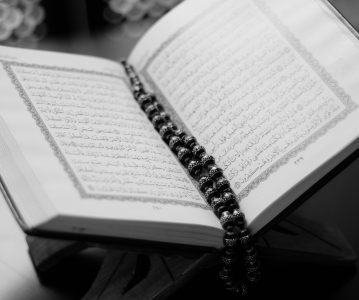

2:200 And when you have completed your rites, remember Allah like your [previous] remembrance of your fathers or with [much] greater remembrance.
And among the people is he who says, “Our Lord, give us in this world,” and he will have in the Hereafter no share.
201 But among them is he who says, “Our Lord, give us in this world [that which is] good and in the Hereafter [that which is] good and protect us from the punishment of the Fire.”
202 Those will have a share of what they have earned, and Allah is swift in account.
Koran 2:200-202
Muhammad spoke about Allah in the third person. This means this passage is not the perfect words of the perfect Qur’an from perfect Allah. Thus, Allah is false, imaginary, and fictional, which means Islamic doctrine and Islam are nonsensical and false.
Muhammad includes the imperfect words of imperfect others, an interlocutor who is only in Muhammad’s mind, instead of the perfect words of the perfect Qur’an from perfect Allah. This means that Muhammad’s recitation, Muhammad’s Koran, is not from Allah, which means Allah, Muhammad, Islamic doctrine, Islam, and Koran are incoherent and false.
What is “their rites”? Muhammad assumes his listeners, his Muslim bandits, will know. They know because of being brought up as pagans. Thus, this shows that Muhammad is including the pagan rites into Islam, so showing Islam has pagan roots and is obviously false.
Notice the “remember”? Can you, as a Muslim, remember Allah? This comes from the ancestor worship cult that Muhammad incorporated into Islam.
This verse is for Muhammad’s Muslim bandits during his time and place, and obviously not for all Muslims of all generations, as he can’t account for several generations of men having the same experience. Think of the young Muslim, and his Muslim father and his Muslim grandfather, altogether after completing their rites, and remembering their fathers. The first Muslim has his father right there. The Muslim father has his father, the Muslim grandfather, right there. And the Muslim grandfather, his father, is in the grave. That’s weird, isn’t it? For more about Quraysh beliefs and how they creep into Islam, read Quraysh Polytheism?
And of course, note the sexism too. Muhammad has this for men only, not for women. Isn’t Islam for women? Muhammad shows Islam is only for men, not women, which is contrary to Islamic doctrine. What about women remembering their mothers and grandmothers? What about men and women remembering their mothers and grandmothers? According to Muhammad, women count for so little that they’re not to be remembered at all. Obviously, this is offensive to all women, mothers and grandmothers.
But, Infidel, it’s about the ancestors! So Muhammad has turned Islam into an ancestor worship cult now? For more about Quraysh beliefs and how they creep into Islam, read Quraysh Polytheism?
But, but, Infidel, it’s about remembering the people who weren’t Muslims! So Muhammad has turned Islam into an ancestor worship cult now? And now you’re acknowledging pagan ancestor worship is part of Islam, that’s even crazier! For more about Quraysh beliefs and how they creep into Islam, read Quraysh Polytheism?
But, but, but, Infidel, it’s about remembering the deeds of earlier Muslims? No, not according to Tafsir Ibn Kathir, 2:200:
During the time of Jahiliyyah, people used to stand during the (Hajj) season, and one of them would say, “My father used to feed (the poor), help others (end their disputes, with his money), pay the Diyah (i.e., blood money),” and so forth. The only Dhikr that they had was that they would remember the deeds of their fathers.
Tafsir Ibn Kathir, 2:200
This is a custom inherited from the pagan tribe Muhammad was outcast from, the Quraysh. It’s not created by Allah. Instead, it’s partially modified by Muhammad to encourage Muslims to add partners to Allah. Shirk. That’s against Islam and Islamic doctrine. Really, really weird and shirk besides. For more about Quraysh beliefs and how they creep into Islam, see: Quraysh Polytheism?
Notice that Muhammad includes an example of the wrong words to say: “Our Lord, give us in this world.” Why bother with this when in the next verse, there are the “right” words to say? A trivial improvement would be to eliminate the wrong words entirely, like this:
2:200 And when you have completed your rites, remember Allah like your [previous] remembrance of your fathers or with [much] greater remembrance.
And among the people is he who says, “Our Lord, give us in this world,” and he will have in the Hereafter no share.201
But among them is he whosays, “Our Lord, Allah, give us in this world [that which is] good and in the Hereafter [that which is] good and protect us from the punishment of the Fire.”202 Those will have a share of what they have earned, and Allah is swift in account.
Koran 2:200-202
Note also that Muhammad is including the words of the pagans here in the supposedly perfect words of the perfect Qur’an of perfect Allah. Obviously, this shouldn’t be here, so the best replacement for this passage is: “”, the empty sentence.


[…] Qur’an 2:200-202 […]
LikeLike