
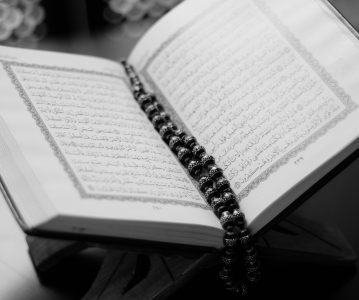

113:1 Say, “I seek refuge in the Lord of daybreak 2 From the evil of that which He created 3 And from the evil of darkness when it settles 4 And from the evil of the blowers in knots 5 And from the evil of an envier when he envies.”
Koran 113:1-5
Muhammad Allah commands Muhammad to: “Say” or “Recite”. This means that this passage is addressed to Muhammad, not to all people. Thus, this passage can’t be in the perfect words of the perfect Qur’an from perfect Allah. As it is addressed to Muhammad, in his time and place, his context, this also means that this passage is locked to Muhammad’s context and can’t be in the context-free, perfect Qur’an from perfect Allah with all its perfect words. Thus, this passage is part of Muhammad’s recitation, Muhammad’s Koran, which means Islamic doctrine and Islam are incoherent and false, meaning Allah is incoherent, imaginary, fictional, and false.
Daybreak

Who is the “Lord of daybreak”? The scholars of Tafsir Ibn Kathir, 113, make clearer the already perfectly clear words of Muhammad Allah with:
Al-Falaq (daybreak) is the morning.
Al-Falaq is the morning.
Tafsir Ibn Kathir, 113
Of course, this is merely the apparent line between dusk and day, the edge of the shadow of the Earth itself.

This chapter is praying about shadows, the edge of shadows, like the shadows we create around a campfire at night:

Night

This part of the prayer is about the Night. The scholars of Tafsir Ibn Kathir, 113, who make clearer the already perfectly clear words of Muhammad Allah, are of several opinions about this, first as Night:
Ghasiq is the night, and when it Waqab refers to the setting of the sun.
Verily, it is the night when it advances with its darkness.
This means the sun when it sets.
Tafsir Ibn Kathir, 113
Then as a star:
This means the star.
The Arabs used to say, Al-Ghasiq is the declination (of the position) of the heavenly body known as Pleiades. The number of those who were ill and stricken with plague would increase whenever it would decline, and their number would lessen whenever it rose.
Tafsir Ibn Kathir, 113
Or as the Moon:
When it becomes dark, it refers to the new Moon, when it’s entirely dark. Such perfect clarity, NOT!
Others have said that it is the moon.
`A’ishah said, “The Messenger of Allah took me by my hand and showed me the moon when it rose, and he said, Seek refuge with Allah from the evil of this Ghasiq when it becomes dark.
Tafsir Ibn Kathir, 113
Blowers in Knots


What are the “blowers in knots”? The scholars of Tafsir Ibn Kathir, 113, make clearer the already perfectly clear words of Muhammad Allah with:
This means the witches.
When they perform their spells and blow into the knots.
Tafsir Ibn Kathir, 113
The scholars of Tafsir Ibn Kathir, 113, have a discussion on witchcraft, which really shows that Allah doesn’t protect Muhammad, thus showing Allah is worthless nonsense, thus Islam, the Koran and Muhammad are false.
But, Infidel, Allah sent angels to cure Muhammad! Who is it that creates magic in the first place?
But, but, Infidel,… It’s Allah who creates the magic that bedevils Muhammad in the first place. This shows the incompetence of Allah, thus the stupidity and foolishness of Muhammad, who knows that “magic” – an imaginary power – has GREATER power than Allah. Magic is imaginary. So, Allah is imaginary, just like magic. Muhammad was a liar, and stupid too, unable to keep his religion coherent, and frightened of imaginary power, so showing he was a false prophet, of a false god, Allah, for a false religion, Islam, without even a false book, the Koran.
The best replacement for this passage is: “”, the empty sentence.

 Koran Contradiction
[…] Qur’an 113:1-5 […]
LikeLike