
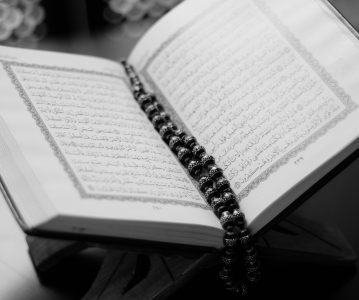

107:1 Have you seen the one who denies the Recompense?
2 For that is the one who drives away the orphan 3 And does not encourage the feeding of the poor.
4 So woe to those who pray 5 [But] who are heedless of their prayer – 6 Those who make show [of their deeds] 7 And withhold [simple] assistance.
Koran 107:1-7
Note the rhetorical question of Muhammad. This is supposed to be obvious to the listener (or reader). Who is “the one”?
But, Infidel, that’s YOU! Indeed, I do deny the “Recompense” or Islamic Paradise and Islamic Fire, as they are nonsensical places, imaginary and false, the carrot and stick of the Muslim donkey, used by Muhammad to get Muslims to obey him, but the rest? So let’s test myself against Muhammad’s prediction. Do I match these predictions, these prophecies of Muhammad, stated as pre-existing facts?
- “For that is the one who drives away the orphan” – I give charity to orphans;
- “does not encourage the feeding of the poor.” – Again, I give in charity to the poor;
- “So woe to those who pray” – I don’t pray as I’m an agnostic atheist;
- “who are heedless of their prayer” – Again, I don’t pray;
- “Those who make show [of their deeds]” – I only show these deeds to you who read this chapter refutation, and I don’t boast;
- “And withhold [simple] assistance.” – Again, I give in charity to the poor.
- Alive at the time of Muhammad – It’s been 1400 years. I’m not that old.
So I don’t match Muhammad’s “prophecy”, and thus Muhammad is an utter failure, as usual. Also note Muhammad’s repetitions, three times about charity, and twice about prayer. Surely once for each is enough? You know, to match Allah’s supposed oneness?
This passage is likely Muhammad’s revenge fantasy against those who treated him poorly as an orphan, and it’s likely to be about the ruler of his tribe, who denied Muhammad’s “rights”.
What can it be replaced with? Simply, love one another; the second commandment of Jesus covers all this and far better. But, as Islam is about obedience to Muhammad, lust and death, the love part is entirely lost by Muhammad.
The best replacement for this passage is: “”, the empty sentence.

 Koran Contradiction
[…] Qur’an 107:1-7 […]
LikeLike