
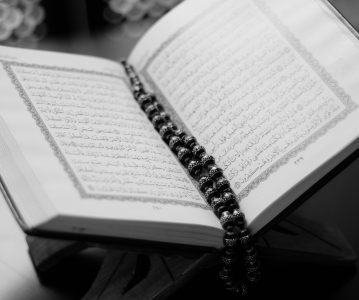

39:17 But those who have avoided ṭāghūt, lest they worship it, and turned back to Allah – for them are good tidings.
So give good tidings to My servants 18 Who listen to speech and follow the best of it.
Those are the ones Allah has guided, and those are people of understanding.
19 Then, is one who has deserved the decree of punishment [to be guided]?
Then, can you save one who is in the Fire?
20 But those who have feared their Lord – for them are chambers, above them chambers built high, beneath which rivers flow.
[This is] the promise of Allah. Allah does not fail in [His] promise.
Koran 39:17-20
This passage is addressed to Muhammad from Muhammad pretending to be Allah. As such, this means that this passage is not the perfect words of the perfect Qur’an from perfect Allah. Thus, Allah is false, imaginary, and fictional, which means Muhammad, the Koran, Islamic doctrine, and Islam are nonsensical and false.
This passage is locked to Muhammad’s time and place, his context, with this explanation from the scholars of Tafsir Ibn Kathir, 39:17, who write:
(Those who avoid At-Taghut by not worshipping them) was revealed concerning Zayd bin `Amr bin Nufayl and Abu Dharr and Salman Al-Farisi, may Allah be pleased with them. The correct view is that it includes them and all others who avoided worshipping idols and turned to the worship of Ar-Rahman.
Tafsir Ibn Kathir, 39:17
Note the untranslated word: “ṭāghūt“. I’ve linked to the Wikipedia definition. Muhammad then commands himself to give “good tidings” to his servants, AKA Muslims. Yet, he promptly fails to do so. Notice how Muhammad contradicts Islamic fate with:
So give good tidings to My servants 18 Who listen to speech and follow the best of it. Those are the ones Allah has guided, and those are people of understanding.
Excerpt, Koran 39:17-18
Notice how Muhammad calls the choices of “My servants” as being the results of Allah’s guidance and praises them for “understanding”. Obviously, choices aren’t guidance.
Notice the rhetorical questions of Muhammad to Muhammad, the second is: “can you save one who is in the Fire?” Recall that according to Muhammad, humans are created for Islamic Paradise or Fire from the start of creation. Also, note that Islamic Fire (and Paradise) has never happened. Muhammad shows he’s a false prophet again.
The last verse seems perhaps to be the good news Muhammad is commanded to tell his Muslims, yet, there’s no “Say” before it. As for the reward? The bottom floor of a two-story building? With rivers outside. Obviously, another incoherent description of Islamic Paradise again. Or perhaps it’s simply this?

Allah (Muhammad) fails in his promises. The people Muhammad was speaking to are all long dead, just like Muhammad. No disaster happened, except for Muhammad and his Muslim bandits.
The best replacement for this passage is: “”, the empty sentence.

 Koran Contradiction
[…] Qur’an 39:17-20 […]
LikeLike