

37:83 And indeed, among his kind was Abraham, 84 When he came to his Lord with a sound heart 85 [And] when he said to his father and his people, “What do you worship? 86 Is it falsehood [as] gods other than Allah you desire? 87 Then what is your thought about the Lord of the worlds?”
88 And he cast a look at the stars 89 And said, “Indeed, I am [about to be] ill.”
90 So they turned away from him, departing.
91 Then he turned to their gods and said, “Do you not eat? 92 What is with you that you do not speak?” 93 And he turned upon them a blow with [his] right hand.
94 Then the people came toward him, hastening.
95 He said, “Do you worship that which you [yourselves] carve, 96 While Allah created you and that which you do?”
97 They said, “Construct for him a furnace and throw him into the burning fire.”
98 And they intended for him a plan, but We made them the most debased.
99 And [then] he said, “Indeed, I will go to [where I am ordered by] my Lord; He will guide me. 100 My Lord, grant me [a child] from among the righteous.”
101 So We gave him good tidings of a forbearing boy.
102 And when he reached with him [the age of] exertion, he said, “O my son, indeed I have seen in a dream that I [must] sacrifice you, so see what you think.”
He said, “O my father, do as you are commanded. You will find me, if Allah wills, of the steadfast.”
103 And when they had both submitted and he put him down upon his forehead, 104 We called to him, “O Abraham, 105 You have fulfilled the vision.”
Indeed, We thus reward the doers of good.
106 Indeed, this was the clear trial.
107 And We ransomed him with a great sacrifice, 108 And We left for him [favorable mention] among later generations: 109 “Peace upon Abraham.”
110 Indeed, We thus reward the doers of good.
111 Indeed, he was of Our believing servants.
112 And We gave him good tidings of Isaac, a prophet from among the righteous.
113 And We blessed him and Isaac. But among their descendants is the doer of good and the clearly unjust to himself [i.e., sinner].
Koran 37:83-113
Muhammad commits shirk with: “We”, “Us” or “Our”, placing Allah as a companion to himself, showing that Allah is incoherent, imaginary, and fictional, and so Islam is incoherent with monotheism, thus Islam is contradictory and false.
Muhammad, in his Koran, addresses a sentence, verse, or passage to “Anonymous They”, with “they”, “them”, “he”, “your”, “the people”, and so on, without naming them. For more, read Anonymous They.
Muhammad includes the imperfect words of imperfect others, an interlocutor who is only in Muhammad’s mind, instead of the perfect words of the perfect Qur’an from perfect Allah. This means that Muhammad’s recitation, Muhammad’s Koran, is not from Allah, which means Allah, Muhammad, Islamic doctrine, Islam, and Koran are incoherent and false.
Muhammad’s story of Abraham is obviously corrupt and corruptly repeated with corrupt variation, so contradicting the oneness of Allah.
Notice the racism of Muhammad with: “among his kind”. Who is the “kind” of Abraham? Jew? Israelite? One of Noah’s brothers, instead of his sons? Christian? Why doesn’t Muhammad declare Abraham as a Muslim? And surely, Abraham was with “his father and his people”, one of the people of Ur? Muhammad’s confusion over this shows he’s not guided by a perfectly clear god, but instead Allah is Muhammad and Muhammad is Allah, and so Islam and the Koran are false.
Note that the “rescue” of Abraham from the “fire” is false.
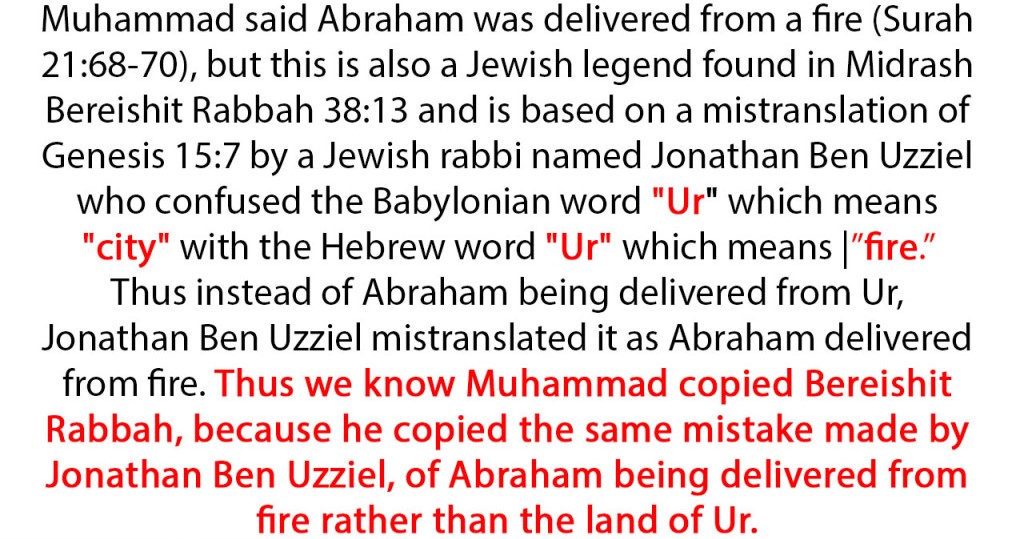
Muhammad getting this wrong, shows his god, Allah, is false, making Islam false too.
What’s that “great sacrifice”?
Abraham looked up and there in a thicket he saw a ram caught by its horns. He went over and took the ram and sacrificed it as a burnt offering instead of his son.
NIV Genesis 22:13
The ram, caught by his horns in the thicket, is the “great sacrifice” and is a foreshadowing of Jesus, wearing the crown of thorns on the cross.

Also note that Muhammad has smooshed together at least two stories of Abraham here together, which is obviously incoherent and so false. For more, see: Genesis Rabbah 38:13.
The best replacement for this passage is: “”, the empty sentence.

 Koran Contradiction
[…] Qur’an 37:83-113 […]
LikeLike