
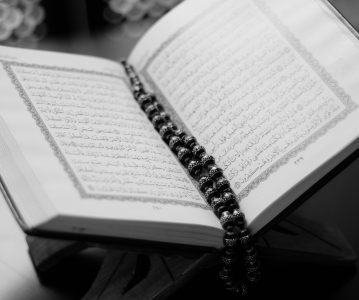

Muhammad’s rant, part 2 of 5.
37:27 And they will approach one another asking [i.e., blaming] each other.
28 They will say, “Indeed, you used to come at us from the right.”
29 They [i.e., the oppressors] will say, “Rather, you [yourselves] were not believers, 30 And we had over you no authority, but you were a transgressing people. 31 So the word [i.e., decree] of our Lord has come into effect upon us; indeed, we will taste [punishment]. 32 And we led you to deviation; indeed, we were deviators.”
33 So indeed they, that Day, will be sharing in the punishment.
34 Indeed, that is how We deal with the criminals.
35 Indeed they, when it was said to them, “There is no deity but Allah,”
were arrogant 36 And were saying, “Are we to leave our gods for a mad poet?”
37 Rather, he [i.e., the Prophet] has come with the truth and confirmed the [previous] messengers.
Koran 37:27-37
Muhammad, in his Koran, addresses a sentence, verse, or passage to “Anonymous They”, with “they”, “them”, “he”, “your”, “the people”, and so on, without naming them. For more, read Anonymous They.
Muhammad includes the imperfect words of imperfect others, an interlocutor who is only in Muhammad’s mind, instead of the perfect words of the perfect Qur’an from perfect Allah. This means that Muhammad’s recitation, Muhammad’s Koran, is not from Allah, which means Allah, Muhammad, Islamic doctrine, Islam, and Koran are incoherent and false.
Muhammad commits shirk with: “We”, “Us” or “Our”, placing Allah as a companion to himself, showing that Allah is incoherent, imaginary, and fictional, and so Islam is incoherent with monotheism, thus Islam is contradictory and false.
Note carefully that the “they” seem to be the Quraysh of Muhammad’s time, with: “the right” (local idiom) and “our Lord” (Allah), and later: “Are we to leave our gods for a mad poet?”. Notice how remarkably informed “they” are, after all, is this stuff in this chapter of the Koran? Obviously not, yet the “they” know this and inform each other. Obviously, this indicates that the printed Koran is corrupt compared to the recitation uttered by Muhammad, and this is confirmed by the last verse where “Muhammad” speaks about himself in the third person, as he who “has come with truth” – the truth being Muhammad’s earlier recitation. This meta-reference shows that the printed Koran, this Koran, comes from Muhammad and friends, and is not from any real Allah. This meta-reference is obviously an addition from a scribe, describing what is happening.
Note as well, that Muhammad claims he has “confirmed the [previous] messengers.” Obviously this means the Bible and Torah, thus contradicting the Islamic doctrine that Torah and Bible are corrupted.
And of course, as this passage shows that the printed Koran is corrupt, compared with the recitation of Muhammad, this means that Allah, Muhammad, Islam and Koran are false.
The best replacement for this passage is: “”, the empty sentence.

 Koran Contradiction
[…] Qur’an 37:27-37 […]
LikeLike