
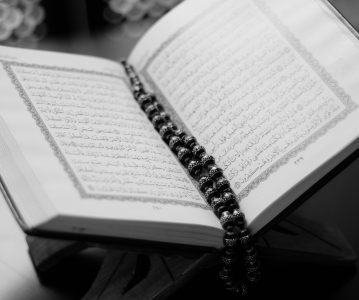

28:56 Indeed, [O Muhammad], you do not guide whom you like, but Allah guides whom He wills.
And He is most knowing of the [rightly] guided.
57 And they say, “If we were to follow the guidance with you, we would be swept from our land.”
Have we not established for them a safe sanctuary to which are brought the fruits of all things as provision from Us?
But most of them do not know.
Koran 28:56-57
Muhammad spoke about Allah in the third person. This means this passage is not the perfect words of the perfect Qur’an from perfect Allah. Thus, Allah is false, imaginary, and fictional, which means Islamic doctrine and Islam are nonsensical and false.
This passage is addressed to Muhammad from Muhammad pretending to be Allah. As such, this means that this passage is not the perfect words of the perfect Qur’an from perfect Allah. Thus, Allah is false, imaginary, and fictional, which means Muhammad, the Koran, Islamic doctrine, and Islam are nonsensical and false.
Note that verse 56 shows that the Koran, Muhammad’s recitation, is irrelevant: “you [Muhammad] do not guide whom you like, but Allah guides whom He wills.” If Allah guides who he wills, then Koran, Islam and Muhammad are worthless nonsense. Consider, if I read the Koran, and decide to become Muslim, then obviously Allah didn’t guide me. Conversely, how do I become Muslim, if I do not have Koran? Does Allah speak to me, and make me another prophet of Islam? Thus, you know straight from Muhammad, that Islam, Koran and Allah are worthless nonsense.
Muhammad, in his Koran, addresses a sentence, verse, or passage to “Anonymous They”, with “they”, “them”, “he”, “your”, “the people”, and so on, without naming them. For more, read Anonymous They.
Muhammad includes the imperfect words of imperfect others, an interlocutor who is only in Muhammad’s mind, instead of the perfect words of the perfect Qur’an from perfect Allah. This means that Muhammad’s recitation, Muhammad’s Koran, is not from Allah, which means Allah, Muhammad, Islamic doctrine, Islam, and Koran are incoherent and false.
Koran 28:56

Indeed, [O Muhammad], you do not guide whom you like, but Allah guides whom He wills.
And He is most knowing of the [rightly] guided.
Koran 28:56
The scholars of Tafsir Ibn Kathir, 28:56, show that this passage is yet another reference to the death of Muhammad’s uncle:
It was recorded in the Two Sahihs that this Ayah was revealed concerning Abu Talib, the paternal uncle of the Messenger of Allah. He used to protect the Prophet, support him and stand by him. He loved the Prophet dearly, but this love was a natural love, i.e., born of kinship, not a love that was born of the fact that he was the Messenger of Allah. When he was on his deathbed, the Messenger of Allah called him to Faith and to enter Islam,
Tafsir Ibn Kathir, 28:56
Obviously, a verse linked to Muhammad’s time and place, his context, and the death of his favourite uncle, can’t be part of the perfect words of the perfect Qur’an from perfect Allah, intended for all times and all places and all peoples. Thus, Muhammad’s mourning, denial and acceptance of death, shows Muhammad’s own coming to terms with the fact of death amongst his relatives. Such personal information shows that Muhammad’s Koran does indeed come from Muhammad (and friends), not from Allah. Thus Allah, Islam, the Koran and Muhammad are false.
Koran 28:57

And they say, “If we were to follow the guidance with you, we would be swept from our land.”
Have we not established for them a safe sanctuary to which are brought the fruits of all things as provision from Us?
But most of them do not know.
Koran 28:57
Notice in the last verse that “we” is not “We”? Is this a translation error? Or a recognition that Muhammad is Allah? See for yourself, I’ve underlined the “we” which should be “We”, which is followed by “Us”, which helps to reveal this problem:
Have we not established for them a safe sanctuary to which are brought the fruits of all things as provision from Us?
Excerpt, Koran 28:57
Later on, the Muslims at Qur’an.com changed their translation to agree with me. You can see the original translation in The Quranic Arabic Corpus still has this problem:
Sahih International: And they say, “If we were to follow the guidance with you, we would be swept from our land.” Have we not established for them a safe sanctuary to which are brought the fruits of all things as provision from Us? But most of them do not know.
Koran 28:57
Notice as well, that the translators have rendered this as a rhetorical question for Muhammad, which is obviously wrong, according to the scholars of Tafsir Ibn Kathir, 28:56, who have this better with:
Have We not established for them a secure sanctuary, to which are brought fruits of all kinds, a provision from Ourselves, but most of them know not.
Tafsir Ibn Kathir, 28:56
Notice the lack of a rhetorical question, which is achieved by combining the rhetorical question with the answer to the rhetorical question. The scholars knew that Muhammad pretending to be Allah and asking rhetorical questions of Muhammad showed Muhammad was insane and a false prophet. And of course, “We” is wrong, as according to Muhammad, Mecca was established as a city by Abraham and his son, not by “We” (LOL). For more, see Koran 14:35-41 and Story of Abraham.
But, Infidel, Abraham dedicated Mecca to Allah, so it’s Allah’s city. Indeed, Allah, the Lord of Mecca, showing Allah is local to Muhammad, the Meccans, and the Quraysh and so is an idol:
And of course, “We” (or “we”) never provide for Muslims, nor make them secure. This is only possible in Petra, Jordan, not at the open Mecca in Saudi Arabia. Compare:

Petra is relatively secure from conquest by the narrow access ways and the constructed wall to the southwest. Compare this with Mecca in Saudi Arabia which is wide open:

Mecca, of course, has no resources, and its only value (to Muslims) is the black stone idol.
The best replacement for this passage is: “”, the empty sentence.

 Koran Contradiction
[…] Qur’an 28:56-57 […]
LikeLike