
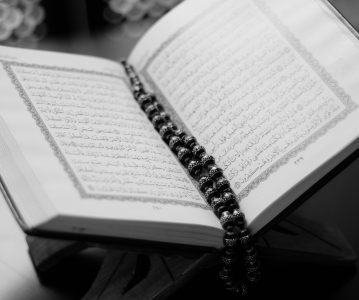

17:107 Say, “Believe in it or do not believe.”
Indeed, those who were given knowledge before it – when it is recited to them, they fall upon their faces in prostration.
108 And they say, “Exalted is our Lord! Indeed, the promise of our Lord has been fulfilled.”
109 And they fall upon their faces weeping, and the Qur’an increases them in humble submission.
Koran 17:107-109
Muhammad Allah commands Muhammad to: “Say” or “Recite”. This means that this passage is addressed to Muhammad, not to all people. Thus, this passage can’t be in the perfect words of the perfect Qur’an from perfect Allah. As it is addressed to Muhammad, in his time and place, his context, this also means that this passage is locked to Muhammad’s context and can’t be in the context-free, perfect Qur’an from perfect Allah with all its perfect words. Thus, this passage is part of Muhammad’s recitation, Muhammad’s Koran, which means Islamic doctrine and Islam are incoherent and false, meaning Allah is incoherent, imaginary, fictional, and false.
Notice that in Tafsir Ibn Kathir, 17:107, the tafsir translation changes the speech marks:
Say: “Believe in it or do not believe (in it). Verily, those who were given knowledge before it, when it is recited to them, fall down on their chins (faces) in humble prostration.“
Tafsir Ibn Kathir, 17:107
Compare with Koran 17:107, where the speech marks enclose a shorter part of the text:
17:107 Say, “Believe in it or do not believe.“
Indeed, those who were given knowledge before it – when it is recited to them, they fall upon their faces in prostration.
Koran 17:107
Compare this with The Quranic Arabic Corpus, which has NO closing speech mark:
Say, “Believe in it or do not believe. Indeed, those who were given knowledge before it – when it is recited to them, they fall upon their faces in prostration,
The Quranic Arabic Corpus, 17:107
Obviously, this is a serious problem. Either the Sahih International translation in Quran.com is wrong, the Tafsir translation is wrong or the Sahih International translation in The Quranic Arabic Corpus is wrong (or all are wrong).
Note that Muhammad demands that people believe in Muhammad’s recitation, not the Koran. This is shirk, ascribing a partner to Allah, this recitation of Muhammad, which wasn’t even a book until after Muhammad’s death.
Muhammad, in his Koran, addresses a sentence, verse, or passage to “Anonymous They”, with “they”, “them”, “he”, “your”, “the people”, and so on, without naming them. For more, read Anonymous They.
Note that the scholars of Tafsir Ibn Kathir, 17:107 claim that the “they” is the:
…righteous people among the People of the Book, who adhered to their Books and appreciated them without distorting them.
Tafsir Ibn Kathir, 17:107
This is obviously nonsense, as copying the words of Jews and Christians and Zoroastrians and Magians and presuming they’re all the same and putting words into their mouth by Muhammad is incoherent with a book supposedly from Allah.
None of the Jews, Christians, Zoroastrians or Magians would do this blasphemy, unless they were extremely naive and didn’t know about Islam and Muhammad’s deceit. And note Muhammad seems very careful to place “our Lord” instead of “Allah”. Obviously, Muhammad can’t say “Allah” because the Jews know their Lord is YHWH and the Christians know their Lord is Jesus/GOD.
Also note their position, falling upon their faces weeping, which is not what Muslims do, in their prayer. Notice the prayer position in the picture at the top of the page. Muslims not falling upon their faces, not weeping.
The best replacement for this passage is: “”, the empty sentence.

 Koran Contradiction
[…] Qur’an 17:107-109 […]
LikeLike