
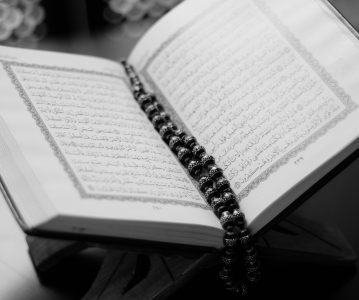

17:94 And what prevented the people from believing when guidance came to them except that they said, “Has Allah sent a human messenger?”
95 Say, “If there were upon the earth angels walking securely, We would have sent down to them from the heaven an angel [as a] messenger.”
Koran 17:94-95
Muhammad, in his Koran, addresses a sentence, verse, or passage to “Anonymous They”, with “they”, “them”, “he”, “your”, “the people”, and so on, without naming them. For more, read Anonymous They.
Muhammad Allah commands Muhammad to: “Say” or “Recite”. This means that this passage is addressed to Muhammad, not to all people. Thus, this passage can’t be in the perfect words of the perfect Qur’an from perfect Allah. As it is addressed to Muhammad, in his time and place, his context, this also means that this passage is locked to Muhammad’s context and can’t be in the context-free, perfect Qur’an from perfect Allah with all its perfect words. Thus, this passage is part of Muhammad’s recitation, Muhammad’s Koran, which means Islamic doctrine and Islam are incoherent and false, meaning Allah is incoherent, imaginary, fictional, and false.
Muhammad commits shirk with: “We”, “Us” or “Our”, placing Allah as a companion to himself, showing that Allah is incoherent, imaginary, and fictional, and so Islam is incoherent with monotheism, thus Islam is contradictory and false.
Note that the first verse is a rhetorical question, where Muhammad inserts his own words into the mouth of the Quraysh. Notice that even Muhammad admits that HIS own people do not know that “Has Allah sent a human messenger?”. Obviously, Muhammad fails at being a messenger, not going to every one of his own people. If Allah was real and not a stone idol, then obviously he should have chosen a better messenger than one that idles in the streets, buys at the market, and dawdles around, as shown in the previous passage.
In the second verse, Muhammad is commanded to say, admitting that Muhammad is a failure at this messenger business. Even Muhammad forgets that he has two (or is it three?) INVISIBLE angels on his shoulders:

But, Infidel, they’re INVISIBLE! So, is it too hard for Allah to turn them visible? Obviously.
And what about Jibril?

Is Muhammad admitting here he knows Jibril doesn’t come from Heaven, from a good god? It seems like it. For more, see Muhammad the Three.
The best replacement for this passage is: “”, the empty sentence.

 Koran Contradiction
[…] Qur’an 17:94-95 […]
LikeLike