
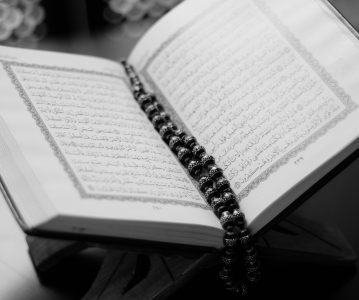

And they request from you, [O Muhammad], a [legal] ruling concerning women.
Say, “Allah gives you a ruling about them and [about] what has been recited to you in the Book concerning the orphan girls to whom you do not give what is decreed for them – and [yet] you desire to marry them – and concerning the oppressed among children and that you maintain for orphans [their rights] in justice.”
And whatever you do of good – indeed, Allah is ever Knowing of it.
Koran 4:127
Muhammad spoke about Allah in the third person. This means this passage is not the perfect words of the perfect Qur’an from perfect Allah. Thus, Allah is false, imaginary, and fictional, which means Islamic doctrine and Islam are nonsensical and false.
Muhammad commands himself: “Say”. Thus showing that this passage is from Muhammad, not Allah. Note that we shouldn’t obey these commands as they’re for Muhammad, not us, and even Muhammad disobeys his own commands.
Muhammad reacts instead of prophesying: “they request from you”. This timing shows that Muhammad is reacting in his time and place, his context, to the concerns of his Muslim bandits and their women and children, some of whom are widows and orphans. Note that these causalities happened because Muhammad ordered his men to attack innocent people for loot, and sometimes Muhammad’s Muslim bandits got killed.
Muhammad lied: “Allah gives you”. But it’s not Allah. It’s Muhammad responding. A wise, powerful and real god would have already provided laws to deal with Muhammad’s problems, before encountering them.
Muhammad continues to lie: “what has been recited to you in the Book”. Note that Muhammad’s Koran is still being recited by Muhammad and only collected piecemeal by scribes, later. There’s no book. Remember, Muhammad left that imaginary book from imaginary Allah behind in the cave. This is also a meta-reference, for Muhammad’s time and place, so showing that the Koran comes from Muhammad, not from a real god.
Muhammad’s Muslim bandits are asking Muhammad for a judgement, a ruling, and what’s worse is that Muhammad is essentially telling his men to remember what he told them earlier in his Koran, he can’t be bothered to deal with the problem at all, instead of competently dealing with the problem. Thus the best replacement for this verse is: “”, the empty sentence.

 Koran Contradiction
[…] to orphans, which are early referred to by Muhammad in Koran 2:219-220 and also in: Koran 4:176, Koran 4:127, Koran 4:7-10, Koran 4:5-6, Koran 4:2-4, Koran 2:215, Koran 2:177 and Koran 2:83, in so many and […]
LikeLike
[…] Qur’an 4:127 […]
LikeLike