

3:65 O People of the Scripture, why do you argue about Abraham while the Torah and the Gospel were not revealed until after him?
Then will you not reason?
66 Here you are – those who have argued about that of which you have [some] knowledge, but why do you argue about that of which you have no knowledge?
And Allah knows, while you know not.
67 Abraham was neither a Jew nor a Christian, but he was one inclining toward truth, a Muslim [submitting to Allah].
And he was not of the polytheists.
68 Indeed, the most worthy of Abraham among the people are those who followed him [in submission to Allah] and this prophet, and those who believe [in his message].
And Allah is the ally of the believers.
Koran 3:65-68
Note Muhammad is describing Allah in the third person. Thus this passage is not the perfect words of the perfect Qur’an from perfect Allah.
This passage is Muhammad arguing, not to the “People of the Scripture”, but to himself. Why? Muhammad never met all the Jews and Christians and Sabaeans. And later, in the verse, with “this prophet”:
Indeed, the most worthy of Abraham among the people are those who followed him [in submission to Allah] and this prophet, and those who believe [in his message].
Excerpt, Koran 3:68
Notice how the Muslim translators added “[in submission to Allah]” to hide Muhammad’s mistake. Here’s how the verse looks, without the additions:
Indeed, the most worthy of Abraham among the people are those who followed him and this prophet, and those who believe.
Excerpt, Koran 3:68
Who follows Abraham? The Jews. Who follows the Jews? Muhammad, “this prophet”. Who follows Muhammad? The Muslims, “those who believe”. If you’re a Muslim, do you follow the Jews and Abraham? Obviously not. Thus these mistakes of Muhammad, which the translators try to cover up, show that Allah is Muhammad, and so Islam and Koran are false.
Muhammad claims that Abraham was: “one inclining toward truth, a Muslim”. Except, as shown by ENCYCLOPEDIA BRITANNICA, Abraham was of the polytheists from the Sumerian city of Ur:
…the seat of a vigorous polytheism whose memory had not been lost and whose uncontested master in Ur was Nanna (or Sin), the Sumero-Akkadian moon god.
ENCYCLOPEDIA BRITANNICA, Abraham
Note that Sin was represented as:
…an old man with a flowing beard—a wise and unfathomable god—wearing a headdress of four horns surmounted by a crescent moon.
ENCYCLOPEDIA BRITANNICA, Sin
In other words, Abraham was rejecting the moon (and cattle) god, Sin, the god Muhammad called “Allah”. For more, see Allah – Cattle God?
But worse, Abraham took up the worship of YHWH in the house of El of the Canaanites:
Bethel was also a holy city, whose cult was centred on El, the Canaanite god par excellence. Its name does not lend itself to confusion, for it proclaims that the city is the bet, “house,” or temple, of El (God). The Canaanite sanctuary was taken over without hesitation by Abraham, who built an altar there and consecrated it to Yahweh, at least if the Yahwistic tradition in Genesis is to be believed.
ENCYCLOPEDIA BRITANNICA, Abraham
History, legend, Torah and Bible agree that Abraham was not “Muslim”, but the first of the Hebrews, as shown by:
There have been many surprising items in the thousands of tablets found in the palace at Mari. Not only are the Ḫapiru (“Hebrews”) mentioned but so also remarkably are the Banu Yamina (“Benjaminites”).
ENCYCLOPEDIA BRITANNICA, Abraham
Notice that Abraham and his people never called themselves “Muslim”. Other people of the time, never called them “Muslims”.
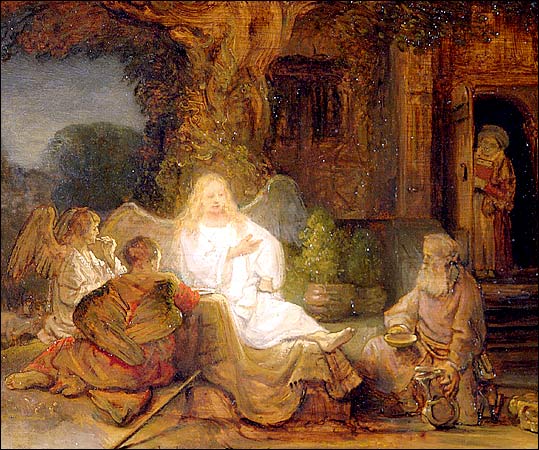
Arguably, Abraham meeting the Trinity, shows that Abraham was the first Christian.
Another opinion:
As shown, Muhammad’s argument is falsified by established history, by Torah and by the Bible, the latter two of which Muhammad accepts. Perhaps if Muhammad had listened to a real god, he would have a far better argument, instead of this delusional nonsense. As Abraham rejected Sin/Allah then Muhammad’s argument is false. So the best replacement for this passage is: “”, the empty sentence.

 Koran Contradiction
[…] was that at Makkah…”. As we note from the established history of Abraham mentioned in Koran 3:65-68, we see that Abraham established a sanctuary in Bethel to […]
LikeLike
[…] Qur’an 3:65-68 […]
LikeLike